|
|
|
|
|
|
|
|
|
A Westinghouse JG-12AT7
premium military tube. Notice the green paint on top. |
|
|
|
|
|
|
|
|
|
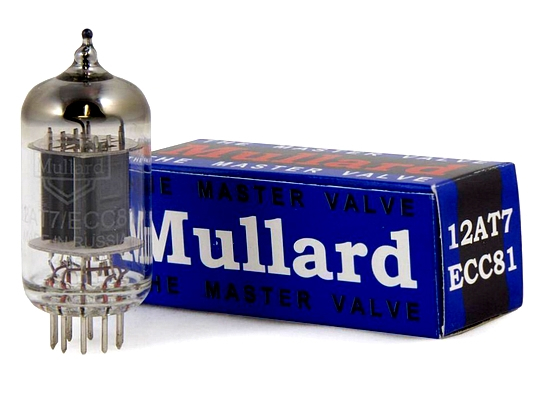
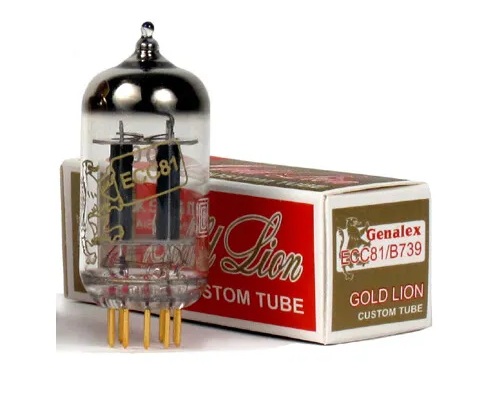
Modern Russian made Mullard and Genalex brand
12AT7s. There is nothing "Mullard" or "Genalex" about them,
except the names. Mullard stopped making vacuum tubes in
1982. Genalex ceased production in 1988. These are both made
by New Sensor Corporation at a facility in Saratov, Russia.
|
|
|
|
|
|
|
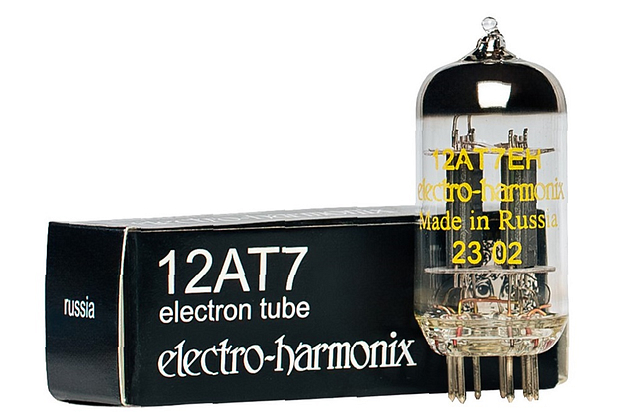
| An Electro-Harmonix 12AT7. This is the "house
brand" of New Sensor Corp. |
|
|
|
|
|
|
|
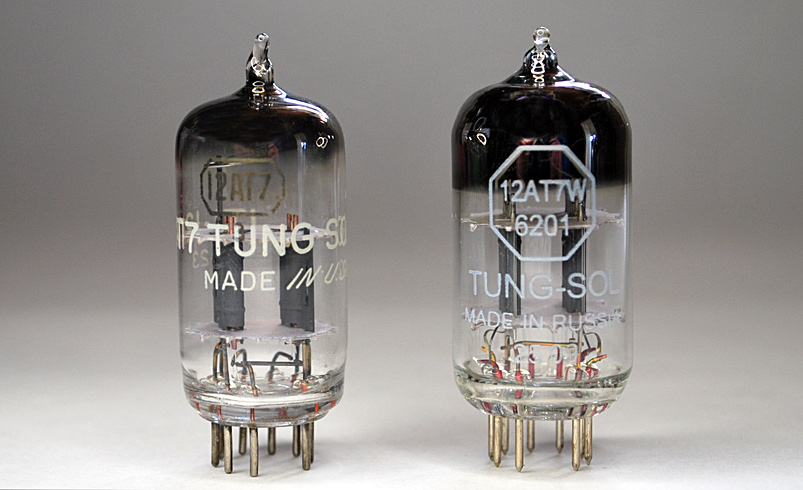
An American and a New Sensor Tung-Sol
12AT7. The Russian tube is larger but the pins are thinner. New Sensor acquired
the Tung-Sol name in May of 2002. I get the feeling that every brand
of 12AT7 made by New Sensor is the same tube with a different logo.
It is interesting that the
Russian tube is labeled both 12AT7W and 6201, because you
don't normally see these together. They designate a higher quality ruggedized
military version of the tube, used in mobile, aircraft and
missile applications. The 6201 is resistant to impacts,
acceleration, vibration, drastic changes in temperature and
cycling on and off. Do you think the Russian
6201 conforms to this standard?
I bought one of
each to find out.
I didn't drop the Russian tube, bang on it 80 times in four
different positions, swing it around at 2.5 times the force
of gravity, put it in the freezer while it was hot, put it
in the toaster oven while it was frozen, or shake it 25 times a second for 32
hours (per the 6201 data sheet), but I did test it. |
|
|
|
 |
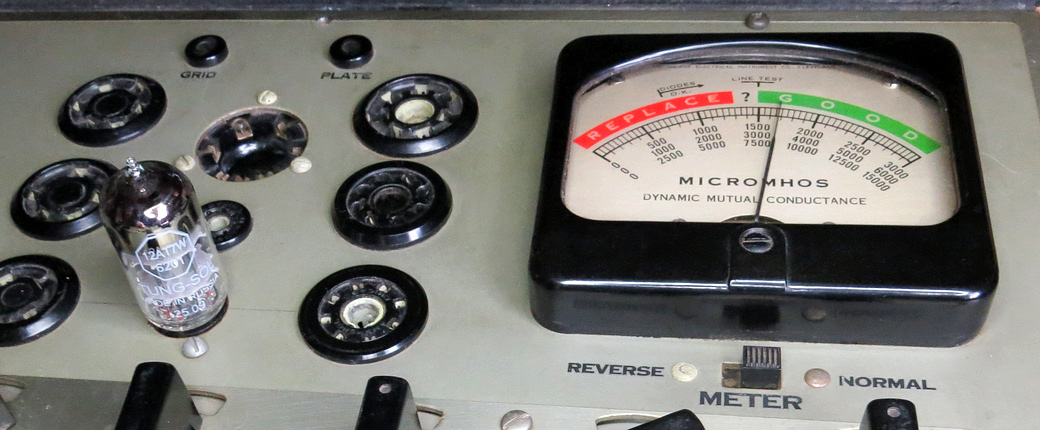
NOTE: The tubes were tested using a
Hickok model 532 tube tester. The target
reading for a 12AT7 is 4000 micromhos. This
agrees with the data sheet for a 12AT7 when
there are 100 volts on the plate.

A micromho is 1/1000 of
a mho. 4000 micromhos is 4 mhos, but what is a mho? It's a unit if
conductance, the opposite of an ohm. Not to
be confused with Moe. |
|
|
|
|
|
|
|
|
|
The first triode had a mutual conductance of 4000
micromhos, which is perfect. The second triode tested at
2400. I sent it back and asked for a
tested tube as a replacement. Both triodes of the
replacement tested about 3400. The American Tung-Sol
tested 4200 / 3900.
| Tube |
Price |
Triode 1 |
Triode 2 |
Gain |
| Tung-Sol
12AT7 |
$20.00 |
4200 |
3900 |
63/58.5 |
| New
Sensor
12AT7W |
$31.99 |
3400 |
3400 |
51/51 ? |
When questioning the
poor test results, a link in the reply pointed to a spec
sheet put out by New Sensor Corp. It states the
amplification factor, or gain, of the tube is 45. (An actual
12AT7 has a gain of 60.) It doesn't show what the tube test results
should be, and because the spec sheet doesn't list the plate
resistance you can't calculate the gain to verify it's
really 45. Additionally, the tube is physically larger than
a vintage 12AT7, and the dimensions on the spec sheet are
incorrect.
It seems they made up their own
specifications and called it a "reissue," but it's not a
6201 or even a regular 12AT7. For $31.99 you can do a lot
better. A new old stock RCA 12AT7 is about half the price of a miserable Russian "reissue."
These three New Sensor
Corp. spec sheets don't agree with each other, though they
are all 12AT7s made by the same company.
The New Sensor
Tung-Sol
spec sheet is
here.
The Electro-Harmonix
12AT7 spec sheet is
here.
The
New Sensor Mullard spec sheet is
here.
For
comparison, the General Electric spec sheet
is
here.
Data sheets
from various manufacturers of actual 12AT7s are
here. |
|
|
|
|
|
|
|
|
|
|
Gold plated pins! |
|
On the left is a used, vintage Amperex 12AT7 with gold
plated pins. On the right is a Russian Genalex, also with gold
plated pins. Just plugging the
Russian tube into a socket scraped off the gold. Whatever the gold colored substance is on the
Russian tube, it doesn't adhere to the pins very well. (Pictures from ebay) |
|
|
|
|
|
|
|
Radio Shack Realistic "Lifetime" brand tubes also had
gold plated pins. "Lifetime" tubes cost more, but were
"guaranteed for life." For example, in 1970 a 12AT7 from
Lafayette was $1.44. A Radio Shack "Lifetime" tube was
$2.19, but if it went bad you got a replacement for free.
That sounds like a good deal, but the guarantee didn't mean Radio Shack would
replace the tube forever. The length of the guarantee wasn't
for the length of YOUR life, and if the tube went bad, it's
life was over. So whose life was it guaranteed for? |
|
|
|
|
|
|
|
|
The "lifetime" was the
"life of the apparatus in which it is used." Radio Shack
began to offer "Lifetime" tubes in 1965 when radios and televisions
that used vacuum tubes were becoming obsolete. Many of these tubes weren't in service
long enough to go bad, so it was a good deal - for Radio
Shack. The salesman would spot you testing your tubes, and
instead of coming home with a new tube for your old radio, you came home with
a brand new
transistorized AM/FM cassette player. By the way, $2.19 in
1970 is $18.29 in 2026. |
|
|
|
|
|
|
|
|
Back in the day when tube counterfeiting was a big business (it
still goes on today) you'd take an American made tube and
rebrand it as a British Mullard or German Telefunkin, but never the
other way around. Nobody ever rubbed off the Mullard label and
stamped "Philco" on it. I find this rather amusing. |
|
|
|
|
|
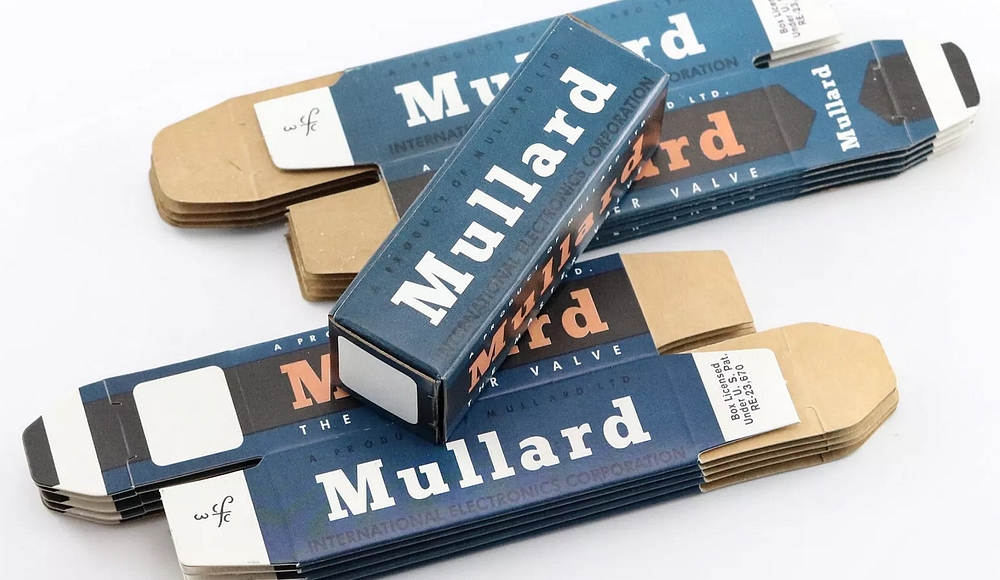
| New "vintage" Mullard tube boxes.
Available on ebay. Be careful when you buy a 12AT7. A $7
tube can be turned into a $70 tube with a damp rag, a
rubber stamp, and a Mullard box. You can purchase boxes for
almost every major brand. |
|
|
|
|
|
|
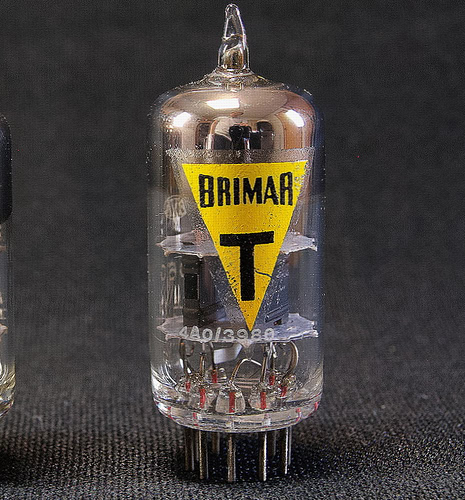
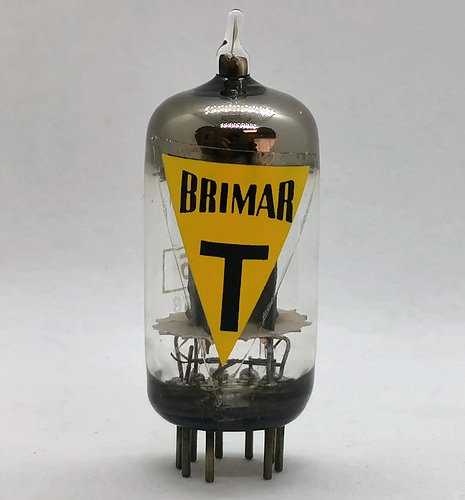
The tube of choice to counterfeit today seems to be the
Brimar 6060, which one site calls "the Holy Grail of 12AT7
preamp tubes." On the left is a Brimar with a "big
yellow T" decal. On the right, the decal looks like a
sticker and it's not the same size. Is it real? How would
you know? The last person you could ask is the guy selling
the tubes. Why are the pins oxidized but the sticker looks
brand new?
It doesn't take much effort to find
a place online that makes stickers. These tubes cost up to
$200 each. If I need to consult a 3rd party tube expert
before I buy a tube I'm not going to bother, notwithstanding
the fact that I would have to be obsessed to pay that much
for a 12AT7. |
|
|
|
|
|
|
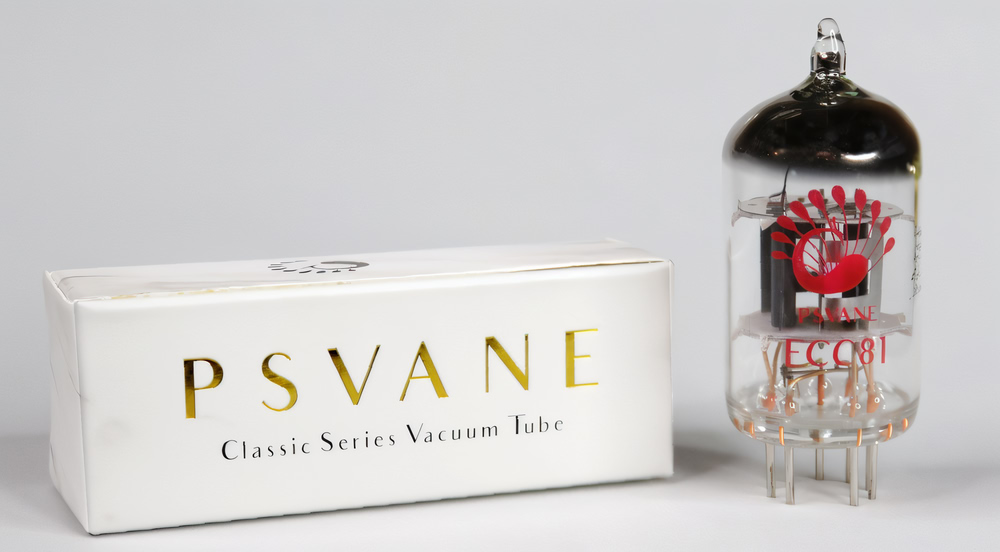
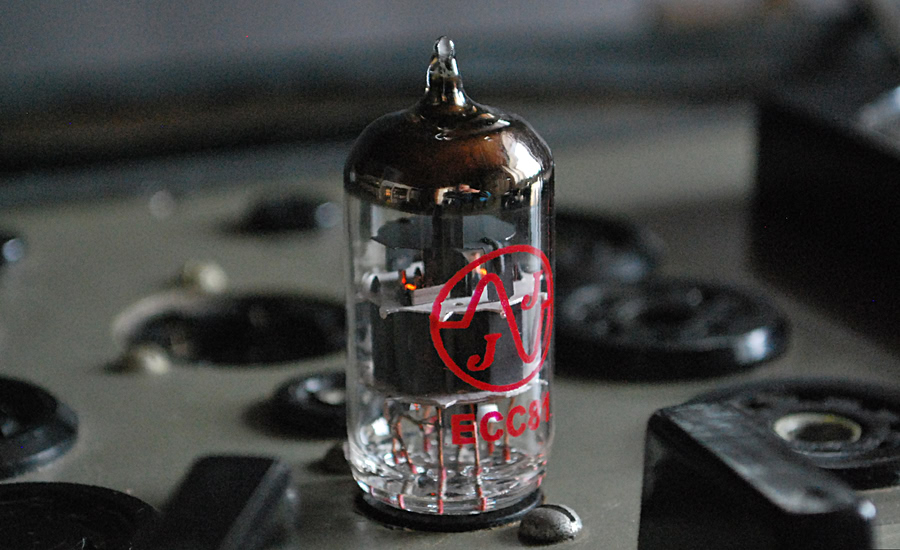
I visited the Ali Express website and bought
a Chinese PSVANE brand
labeled ECC81 (the European designation of a 12AT7). Like
the Russian tube, the diameter is larger than a
vintage 12AT7. (Coincidence?) The price was $13.74.
Was that
a good price? You can buy a new old stock General Electric
12AT7 for less.
The box is a little too "elegant" for my liking. I think it looks like
a
personal care product came in it. "Honey, I've got that rash again.
Can you get me the Pissvane from the medicine cabinet?" |
|
|
|
|
|
|
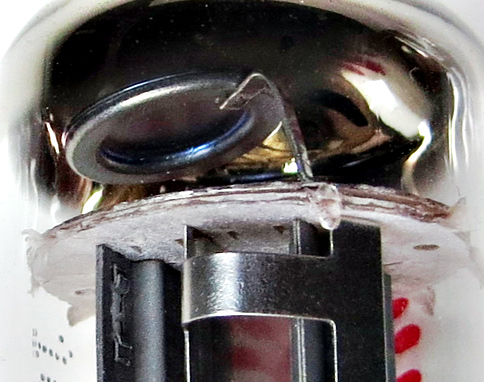
There is an unusual structure inside the tube. It holds up a post that has the getter ring
attached to it. I went back to Ali Express to see what I had
ordered, and none of their ECC81 tubes had this thing in the
pictures. |
|
|
|
|
|
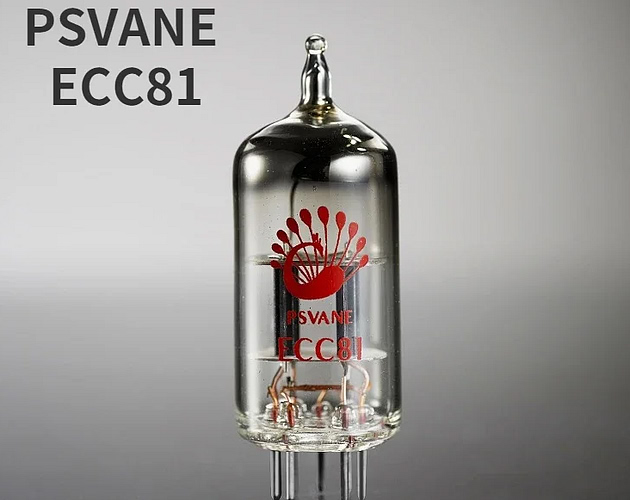
Picture from Ali Express. The odd structure holding
the getter is not inside the tube.
Dang, none of my pictures turn
out this good. How do they do it? |
|
|
|
|
|
|
|
The Ali-Express photos are enhanced. Here's my attempt.
I'd buy the one on the right, it looks like it sounds better! (It's
the same picture.) |
|
|
|
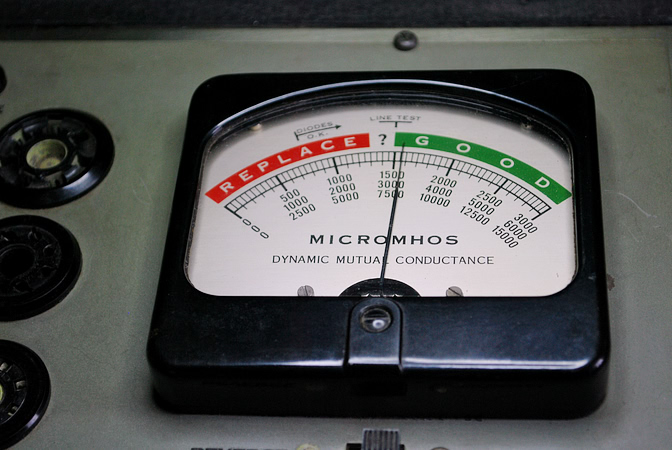
Now for the test! Both triodes of a new 12AT7 should
read at least 4000 on the middle scale of this meter. One
triode of the PSVANE tube read 2800 and the other one gave a
reading of 3100, which is worse than its Russian counterpart.
A 12AT7 should read 3800 after 500 hours of use at the maximum plate
voltage of 250 volts. This new one from China seems like it's been
in use for a thousand hours already.
PSVANE must be selling the rejects of their "premium" versions.
Fortune cookie say, "Gullible man buy cheap tube." PSVANE
also makes a version that they sell for over $100. Do you
want to take a chance on it? Not me! |
|
|
|
|
Like New Sensor, the PSVANE data sheet
does not tell you what the test results should be. From
looking at reviews on Amazon and my own experience, I've
found you're
liable to get a junk, mis-matched tube in the mail. If you
complain, they send you a better one.
I purchased
the Russian Tung-Sol 12AT7W/ 6201 from an online tube store
via Amazon. When I found how bad it was, I returned it for a replacement.
The seller
sent the replacement but told me I had sent him back a tube that was ten years old.
He
was going to charge my credit card for two tubes. It seemed to me he thought he'd get a
double payment for his POS vacuum tube. If the tube he got back was actually ten years old
it's because that's what he sent me. Eventually things
were resolved, the first tube was refunded and I kept the
second tube.
I didn't
return the Chinese PSVANE, because I purchased it EXPECTING
it to be bad. |
|
|
|
| Tube |
Price |
Triode 1 |
Triode 2 |
Gain |
| Tung-Sol
12AT7 |
$20.00 |
4200 |
3900 |
63/58.5 |
| New
Sensor
12AT7W |
$31.99 |
3400 |
3400 |
51/51 ? |
PSVANE
12AT7 |
$13.74 |
2800 |
3100 |
42/46.5 ? |
|
|
|
|
|
|
Why is the 12AT7 still being made today in Russia and China? Why would you want a new one?
Of what use today is a vacuum tube designed in the 1940s for
television sets? It
would take FIVE BILLION of them to make a CPU used in a
typical smart phone or home computer.
They are used in guitar amplifiers! They work fine at audio
frequencies and are listed online
as "preamp vacuum tubes." People who play guitars have
driven up the price of vintage 12AT7s to the point where it
became profitable to manufacture new ones, and the demand is
over one million per year.
Tube sellers extol the virtues
of various brands when used in guitar amplifiers. One site states, "If you are looking for
clarity and headroom go for grey plates, if you would like
more warmth and a richer overdrive sound go with black
plates!"
The color of the plates makes no
difference whatsoever. "Headroom" is a lack of distortion
and "overdrive sound" IS distortion. These characteristics
are obtained with the circuitry and controls in the
amplifier, not by changing tubes that have different colors
inside.
Other descriptions of the output of various
brands include (but are not limited to) robust, sweet,
articulate, smooth, defined, warm, clear, and detailed, as
well as descriptions of texture, responsiveness, realism, clarity,
low-end sound and high-end sound. All of these are supposed
to change while swapping tubes in an amplifier, a process
known as "rolling." You need a different 12AT7 for each
trait, after all they're in the business of selling tubes!
What people are actually hearing while swapping tubes are
the differences in the poorly performing Russian and Chinese
12AT7s. |
|
|
|
|
|
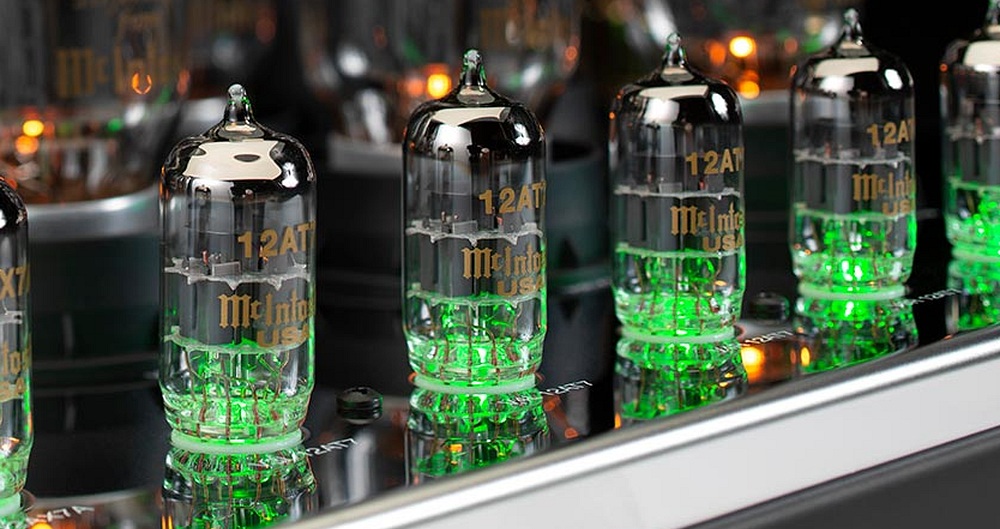
12AT7 vacuum tubes in a modern McIntosh tube amplifier,
illuminated from below with green LEDs. They are
labeled "McIntosh USA" but they were manufactured
in Slovakia, Russia. McIntosh
Laboratory is not named
"McIntosh USA," yet that's how the tubes are
labeled. Is this a marketing stunt?
In response to an
email questioning this, a McIntosh tech wrote that the tubes were made by JJ
Electronic but didn't explain why they were labeled "USA." A
second email went unanswered. The amplifier in this photo
(McIntosh MC1502) lists for as much as $14,000, but they
won't answer a simple question about the vacuum tubes. Nice! |
|
|
|
|
|
|
|
Since JJ tubes are used in
such expensive amplifiers, let's test one! Here's a brand new JJ. |
|
|
3000 and
3100 micromhos. Marginally better than the cheap PSVANE.
|
|
|
TEST RESULTS |
|
|
| Tube |
Price |
Triode 1 |
Triode 2 |
Gain |
| Tung-Sol
12AT7 |
$20.00 |
4200 |
3900 |
63/58.5 |
New
Sensor
12AT7W |
$31.99 |
3400 |
3400 |
51/51 ? |
PSVANE
12AT7 |
$13.74 |
2800 |
3100 |
42/46.5 ? |
JJ
Electronic
12AT7 |
$18.95 |
3000 |
3100 |
45/46.5 ? |
|
| Test results of the modern tubes
show they come new from the factory as if they already have
thousands of hours on them. They should be considered bad,
or at the very end of their usefulness, compared to a
vintage 12AT7. |
|
|
|
THE TAKEAWAY:
The 12AT7 has de-evolved from a radio frequency amplifier and
oscillator (up to 300 megahertz) with an amplification
factor of 60, to an audio frequency amplifier with an amplification
factor of 45. The "re-issues" will
work poorly in antique equipment and are now marketed for
modern audio amplifiers. Though a logical evolution of its
use due to obsolescence of the equipment it was originally
designed for, the new lower specifications should have resulted in a new
tube designation. This could be the case with the 12AT7EH,
but the EH stands for "Electro-Harmonix," not a new version
of the 12AT7.
The two triodes of a new tube should match in performance. A convenient but imprecise way to evaluate a modern
12AT7 is to swap it with a working one and note the
difference in audio output. In the past, if a more accurate
test was wanted, drug stores, hardware stores and electronics shops had tubes
testers, but these machines disappeared decades ago. Knowing that a newly
purchased tube may never be tested by the user, a seller
can supply a tube that is marginally performing,
with triodes that are mis-matched and out of
spec.
Tube sellers use the color and length of the
plates as well as the shape of the getter support structure
as a sales pitch, making various nonsense claims based on
these characteristics. Foreign tube manufacturers have
purchased American and European brand names and deceptively
(but legally) market their tubes under these names, along
with the designations 12AT7W and 6201. Modern spec sheets
omit specifications, state incorrect specifications, and
lower the specifications to make the spec sheet match the
tube. Missing data makes it difficult to calculate the
tube's actual amplification factor. Modern 12AT7s are
acceptable for use in musical instrument amplifiers, which
operate at a fraction of the frequencies the tube was
designed for.
Russia and China both make 12AT7s that
cost over $100 each. I suspect (with no evidence
whatsoever) that these versions will test much better. There
are plenty of NOS American made tubes on ebay for a fraction
of that price that meet the specifications of an actual
12AT7. |
| |
|
|
|
When I
need to buy a 12AT7 for my radio I want reparations from
guitar players, and I want Steve Hackett to deliver the
check so I can get a picture of us together so it looks like I'm his
friend or something. |
|
|
|
|
|
Like this, but the picture won't be fuzzy and instead
of a CD it will be a check made out to me.
Photo taken at the Sellersville Theater, Sellersville, PA |
|
|
|
|
|
|
|
|
| |
|
|
| |